A Leaving Present That Never Left
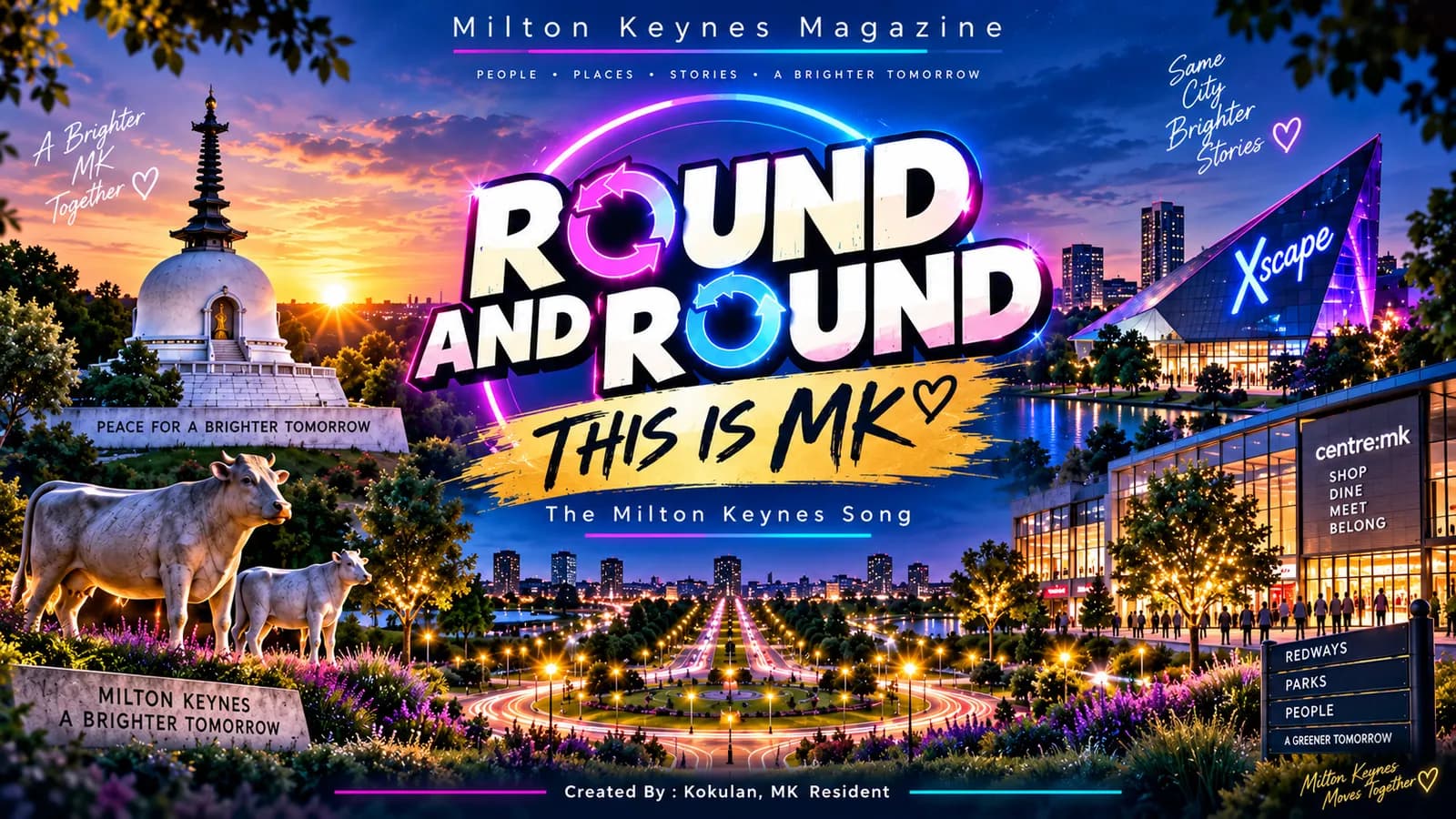
In 1978, American artist Liz Leyh created a set of fibreglass-reinforced concrete cows as a "leaving present" from the Milton Keynes Development Corporation. What began as a temporary community art project has evolved into the city's most recognisable symbol and, perhaps, the perfect metaphor for how Milton Keynes learned to embrace humour as part of its civic identity.
The Artist and Her Materials
Leyh, born in Utica, New York, to Polish immigrant parents, served as artist-in-residence during the early days of Milton Keynes' development. Her materials were deliberately humble: scrap metal armatures, chicken wire, newspaper stuffing, and fibreglass-reinforced concrete donated by a local builder. The three cows and three calves were constructed at Stacey Hill Farm near Wolverton, now the site of Milton Keynes Museum.
Each sculpture features a distinctive heart shape as part of the pattern on the cow skin. The original colour scheme included brown tones, though the familiar black and white appearance that residents recognise today came later through council painting.
A Deliberate Joke
The cows were conceptual art with a sharp sense of irony. At a time when critics dismissed Milton Keynes as nothing more than concrete pavements replacing farmland, Leyh responded by creating literal concrete cows. The work poked fun at preconceived notions of the new town, transforming a dismissive insult into something playful and enduring.
Real farms with real cows lie within two miles of the sculptures' location, a detail that underscores the tension between Milton Keynes' agricultural past and its modernist present.
A History of "Affectionate" Vandalism
Perhaps nothing demonstrates local attachment to the cows more than the catalogue of indignities they have suffered over the decades. The sculptures have been painted pink, transformed into zebras, beheaded multiple times, and dressed in painted pyjama bottoms. During the BSE crisis, vandals added "BSE" graffiti. One calf was once kidnapped, with ransom notes sent to local newspapers. A papier-mâché bull briefly joined the herd.
In October 2012, the cows appeared as skeletons overnight, with the artist having carefully painted anatomical details onto the sculptures. The estimated repair cost was £2,000, but the public response surprised officials. Hundreds of residents sent messages supporting the skeletal version, and The Parks Trust decided to keep the "makeover" until after Halloween. David Foster, then Chief Executive of The Parks Trust, noted: "The public has also offered to help with restoring them and we're grateful that people care so much about the cows."
Carys Underwood of Destination Milton Keynes, whilst condemning the vandalism itself, observed that "the person who has done this has really thought about this and really taken a lot of care and they do look amazing."
From Local Curiosity to National Icon
The cows' reputation has grown substantially since their creation. In 2005, they were included in "The Sculpture 100" list on Sky Television as one of the 100 most influential works of 20th-century open-air sculpture in England. In 2014, two cows featured at the British Pavilion at the Venice Biennale of Architecture, bringing this piece of Milton Keynes to an international audience.
The sculptures have permeated popular culture in other ways. Milton Keynes Dons F.C. named their home supporters' stand "The Cowshed" and briefly nicknamed their stadium "The Moo Camp" in reference to Barcelona's Nou Camp. The club's mascots, "Donny" and "Mooie," are pantomime-style cows. Actor Russell Crowe joked about the sculptures during a 2007 promotional tour for the film 3:10 to Yuma. They have appeared in literature, including Charles Stross' The Concrete Jungle and Mark Wallington's Destination Lapland.
Where to Find Them
The original sculptures moved to Milton Keynes Museum on McConnell Drive, Wolverton, in spring 2016. Bill Griffiths, Director of MK Museum, said at the time: "Within the next few years, our new galleries will be telling the whole story of this area, from pre-history through to the present time and the cows are an important part of the story."
Replicas created by artist Bill Billings stand at Bancroft, beside the A422 between V5 Great Monks Street and V6 Grafton Street, near the West Coast Main Line and A5 junction. These are accessible on foot or by bicycle via the redway system, with the nearest rail stations at Milton Keynes Central and Wolverton.
What the Cows Represent
The Concrete Cows embody something essential about Milton Keynes. A city planned as a "city in the forest" with substantial green space chose as its symbol an artwork that satirises its own concrete reputation. The repeated vandalism, far from destroying the cows' significance, has reinforced local attachment. Residents have claimed ownership of the sculptures through pranks, protests, and restoration offers.
In a nation where new towns often struggle to forge distinct identities, Milton Keynes turned a dismissive epithet into its most beloved landmark. The cows suggest a city comfortable enough to laugh at itself, and perhaps that is the most confident statement of civic identity of all.